Next edition · October 21–22, 2026
The Open Scientific Intelligence Hackathon
presented by the Materials Discovery Research Institute
Formerly the LLM Hackathon for Materials Science & Chemistry — now open to the physical sciences and mathematics. Covering agents, LLMs, datasets, benchmarks, models, scientific software and more against the biggest problems. Free, hybrid, and international.









About the hackathon
Every year, this hackathon brings together scientists, mathematicians, and AI researchers from around the world for an intense sprint: build something real, in teams, across time zones and on-site locations.
Three editions in, the frontier has moved past language models alone — so the event has expanded in scope. As the Open Scientific Intelligence (OSI) Hackathon, the 2026 edition expands from materials science and chemistry to the physical sciences and mathematics, and welcomes submissions in: LLMs, autonomous agents, datasets, benchmarks, models, scientific software, and more.
The 2025 edition produced automated research assistants, novel data pipelines, and agentic lab workflows — explore them on the awards page. The next edition runs October 21–22, 2026 — registration is open. Join the Slack community to find teammates or propose hosting a site.
Three editions and counting
The proof of concept
14 LLM applications built in a single sprint, published as a peer-reviewed paper in Digital Discovery.
Going global
34 projects across 7 on-site locations and a worldwide virtual cohort, documented on arXiv.
Agents arrive
Agentic workflows, tool use, and lab automation took center stage — 120 projects across 16 sites, documented on arXiv.
Next: the OSI Hackathon · October 21–22, 2026
The event becomes the Open Scientific Intelligence Hackathon — expanding to the physical sciences and mathematics, where LLMs, agents, datasets, models, and scientific software are all fair game. Registration is open now; the detailed schedule follows.
Featured videos
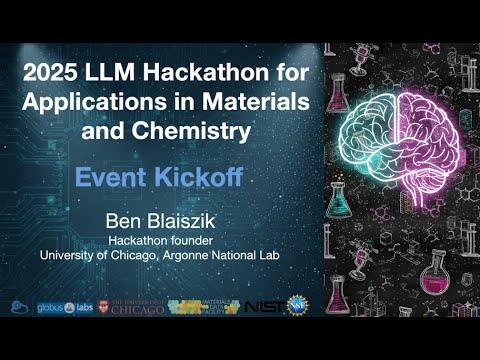
2025 LLM Hackathon for Applications in Materials and Chemistry - Event Kickoff
In this kickoff video, Ben Blaiszik introduces the hackathon, its purpose, and what participants can expect over the next few days. Together, we’re building a global community of innovators and builders who are pushing the boundaries of what’s possible in materials science, chemistry, and drug discovery using large language models (LLMs) and multimodal AI.
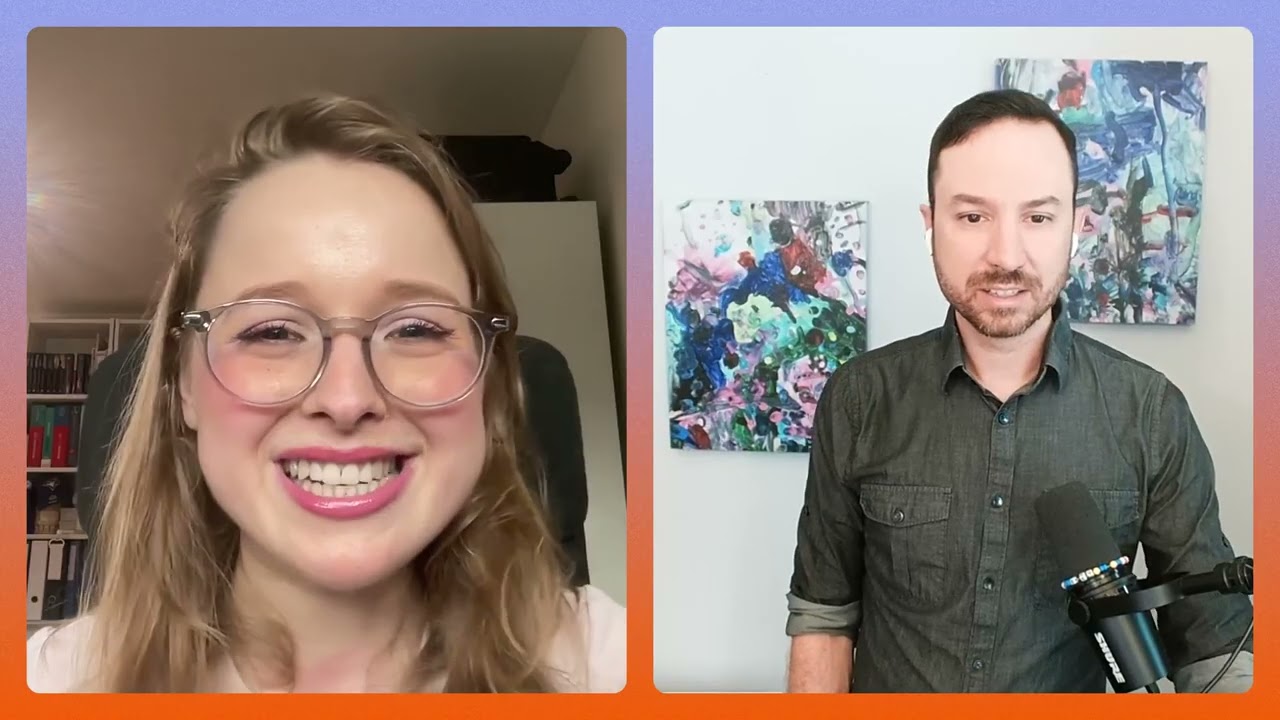
2025 Magdalena Lederbauer: Breaking Down Barriers in Science: AI Tools for Better Research Communication
In this conversation, Magdalena Lederbauer shares her journey at the intersection of chemistry and machine learning, especially using LLMs. She discusses her experiences at ETH Zurich, her participation in hackathons, and the development of GlossaGen, a tool designed to create glossaries from scientific literature. The conversation also introduces a template for hackathon participants to rapidly create applications.

2025 Chenru Duan: From MIT PhD to AI Startup: Creating Better Benchmarks for AI-Driven Scientific Research
Join us for an in-depth conversation with Chenru Duan, founder and CTO of Deep Principle, as he discusses his journey from MIT PhD to AI startup and introduces the groundbreaking Scientific Discovery Evaluation (SDE) Framework. Unlike traditional AI benchmarks that focus on textbook-style Q&A, SDE Harness evaluates LLMs on iterative scientific discovery workflows - hypothesis generation, experimentation, observation, and refinement.

2024 Elsa Olivetta (MIT), Calvin Li (Fum), Marwin Segler (Microsoft), and Michael Craig (Valence) LLM Hackathon for Applications in Materials and Chemistry Kickoff
Speakers include Elsa Olivetta (MIT), Calvin Li (Fum), Marwin Segler (Microsoft), and Michael Craig (Valence). This video also includes event kickoff information and teaming support.

2023 Kevin Jablonka: LLMs in Materials and Chemistry - Why ML Can Find a New Material, But Not a Needle in a Haystack
Kevin Jablonka from EPFL describes the implications of large language models and new software for materials and chemistry discovery.Topics include: Background ML in materials with tabular data; LLMs as a general model creation platform for materials science; Software to simplify application of LLMs to materials and chemistry; ChemChain (using LangChain) to combine chemistry-related tools with almost no code

2023 Andrew White: LLMs and GPT4 in Materials and Chemistry - How to Be a Chemist in 2023
Andrew White describes the implications of large language models and new software for materials and chemistry discovery. Topics include: How to search for information in 2023; Paper-QA; Agent based Paper-QA extension; GPT4; Synthesis to property prediction mapping skipping structure

2023 Christian Dallago: LLMs for Applications in Chemistry - BioLLMs and All That Jazz
As part of the LLM for Applications in Materials and Chemistry Hackathon, Chris Dallago gives an overview of NVIDIA software and tools to facilitate for materials and chemistry discovery. Topics include: NeMo Framework and BioNeMo; 3D Parallelism for Building Foundation Models; MegaMolBart; MolMIM molecular auto encoder
2025 sponsors




Thank you to everyone who supported the 2025 edition — see all sponsors and how to get involved.
Frequently asked questions
Who can participate?
Students, researchers, and professionals from all backgrounds are welcome.
Is there a participation fee?
No, participation is completely free.
What is the team size?
The ideal team size is anywhere between 3 and 10 participants. But there is no enforced limit on size.
What do I need for the hackathon?
You will need a reliable internet connection and access to a few tools that will be used during the event. Make sure you check out our Tech Stack above, and have signed up for all those services.
How will I interact with the other attendees?
You can interact with others via the Slack, Zoom, Miro. Separate team meetings separate team meeting locations should bedefined for discussions.
What kind of mentorship will be available?
We will have a team of experienced mentors from both academia and industry via Slack to help you with your projects.
What will be the judging criteria?
1. Potential for impact: Using what you know about the particular domain, how could this project impact research done in this field? Looking at past research, would his project make better research outcomes or accelerate research in the future?
2. Innovativeness: Does this project stand out? Is it a unique approach? Does it make researchers' lives easier?
3. Scalability: At what point does this project stop scaling? Can the project scale up to accommodate more users? Can this project serve its intended audience as is or does it have the capability to grow with users?
4. Relevance to materials science and chemistry: How relevant is the project in terms of advancing the research in materials science and chemistry?